Showing posts with label clothing and choice. Show all posts

24 June 2010

My Two Wardrobes

self-portrait of a redheaded blogger
Tie-dyed shirt, thrifted
Butterfly pendant, estate sale, remixed

I've been thinking a lot about this post recently, and the significance of editing - the self-editing just about every blogger does.

I don't show you all my clothes, Fabulous Readers. You don't see my gardening/scrubbing/home construction grubbies, the baggy board shorts I go kayaking in, my lounge-around-the-house-in-a-funk pajamas, my ad-hoc workout wear. You also don't see outfits on days, like today, where after half an hour with the camera I haven't been able to get a single photo that looks decent, that approximates what I see in the mirror.

Is that vain? Absolutely. But there are a lot of facets of me that I don't discuss on this blog: my politics, my religious views, my other areas of interest, what I had for dinner. That's not why you come here, which is also the reason I don't attempt to encyclopedically document every single thing that I put on my body, in some mad quest to be fashion blogging's answer to Samuel Pepys. You read my blog, I hope, to see and hear about my particular (peculiar?) perspective on fashion, its whys and wherefores - and hows.

Clothing might not shape our self-image in toto, but it does help define it to the world at large. I don't expect my clothes to express the sum of my personality to the world at large: instead, they present a carefully-edited version of myself, the parts of me I choose to show.
That process of editing, of choice, is what really fascinates me about fashion. Why do we make the choices we do? What determines why I find one shirt cute and another so unflattering as to only be suitable for the most menial of tasks? Why do we emphasize some parts of our bodies and desperately try to camouflage others?

It's easy to say "because of the dominant social paradigm" in response to all of these questions, but I think that's too simple an answer, and maybe even a bit of a cop-out. What are the forces that drive that paradigm? Where do they come from and what influences them? And what about the people who stray from that paradigm, by degrees minuscule or dramatic? What inspires them?

What do you think? Should style blogging be encyclopedic, a comprehensive catalog of what one person (or several) wears, or would you rather see a carefully thought-out selection of outfits a blogger thinks are interesting, inspiring, or attractive? What degree of (self-) editing is all right before a blogger loses authenticity and thus authority - some? None? Lots? No upper limit? Are style blogs more like diaries or one-person fashion magazines?

PS. Apologies to all you Fabulous Readers who subscribe via RSS: I don't know why this published while I was halfway through writing it!

01 June 2010

Uniform chic

Last week, Worn Through featured an article by Tove Hermanson entitled "Festishizing Military Gear."  It's a great piece, and I can't fault Ms. Hermanson's conclusion that sexualizing the horrors of war is unacceptable. However, I'm not entirely certain that the prevalence of military gear in fashion is a result of the fetishizing of war, per se: rather, it represents an ongoing fascination with the uniformed body.

There's a lot of history behind militaria in fashion. Just about as soon as people started making armor, it became not only a statement of power, but one of style. Ancient Greek artifacts show arms and armor decorated with beautiful motifs: Roman senators and emperors were depicted in their armor on coinage and in statuary.

By the later Middle Ages and early Renaissance, it became the norm for men to combine pieces of their garnitures, or suits of armor, with their softer, fancier 'street' clothes for portraiture. Not surprisingly, the clothing worn by even unarmored men began to resemble the padded, segmented garments worn for protection under the heavy metal harnesses. So, to an extent, did those of women: some fashion historians theorize that the rise of the corseted female body, which began in this period, was an adaptation of the structured, armored male torso.

Borrowing from military styles has been an integral part of fashion ever since. In the late 1700s, women wore Spencer jackets, often decorated with epaulets, braid, and other ornaments of the era's military insignia, over their diaphanous Empire-waisted gowns. Cardigans were the innovation of a British commander during the Crimean War. Khakis, trench coats, duffel bags, Breton stripes, and other perennial fashion favorites are all of military origin.

Fashion has always had an uneasy attraction to the concept of uniform. Dress, in our society, is supposed to be a means of self-expression, which is an antithesis of the concept of the uniform. However, fashion itself represents a type of uniform: What's in style this season? What looks are the designers showing? Very few people dress with true individuality.

Uniform goes deeper still. All individuality is, in theory, subsumed into the uniformed whole. What this means in practice is that any expressions of individuality lie in two fields: the manner in which the uniform is worn and the body inside it.

It's the second factor, I think, that is one cause of fashion's ongoing fascination with uniforms and militaria. The only time a uniformed individual is able to show his or her individuality is when the uniform is removed. There's an inherent eroticism in the concept that, in order to have the freedom of expression that we consider a necessary component of personhood, the uniformed individual must be unclothed.

If the fetishizing of uniform was entirely about glorifying war, why would other uniform images - schoolgirls, nurses, even clergy - have such a strong presence in fashion and erotica both?

Another contributing factor is the growing casualness of dress in our society. Uniform, in many cases, indicates a more formal mode of dress, or at least the possibility of its existence. Even in work clothes, though, military clothing hints at the possibility of greater formality: the most tattered-looking soldier has a formal dress uniform somewhere.

A quote from a vintage pattern seller featured on Gertie's New Blog for Better Sewing made me think about the power and authority of formal uniform: "The hat, the crisply starched white dresses, the white shoes that nurses used to wear commanded respect. The nurse's uniforms conveyed an authority that the sloppy scrubs with teddy bears that many nurses wear today do not." In many professions, the uniform is now a polo shirt in company colors: crisp shirts and ties have fallen by the wayside. That's not the case in the military, one of the few truly uniformed institutions remaining in our society. Adapting the trappings of the military allows the wearer to borrow a little bit of the perceived power and authority of the uniformed soldier - an interesting dichotomy, because in many situations, soldiers themselves have less say in their career paths, living arrangements, and, obviously, dress, than the non-military person adapting military imagery.

The dress regulations of the US Army fill a book of not inconsiderable size. In any circumstance, a soldier has guidance and direction as to what to wear and how. How many of us, when faced with the welter of choices presented by fashion's conflicting messages, haven't wished for that sort of guidance, even if just for a moment? The popularity of, and fascination with, capsule wardrobe challenges and The Uniform Project among style bloggers indicate that the concept of a limited, dictated wardrobe has appeal, even - perhaps especially - among people who are immersed in the culture of self-expression through fashion.

Separating the uniformed soldier from the war is a fine line: perhaps it's an imaginary one. My perspective on this matter is not unbiased - I'm married to a US Army veteran, which colors my understanding of the military. However, I think that saying that militaria in fashion is little more than a glorification of war sells both fashion and the military sadly short.

27 April 2010

Pattern madness

Up until recently, I was terrified of wearing patterns at all, let alone several in combination.

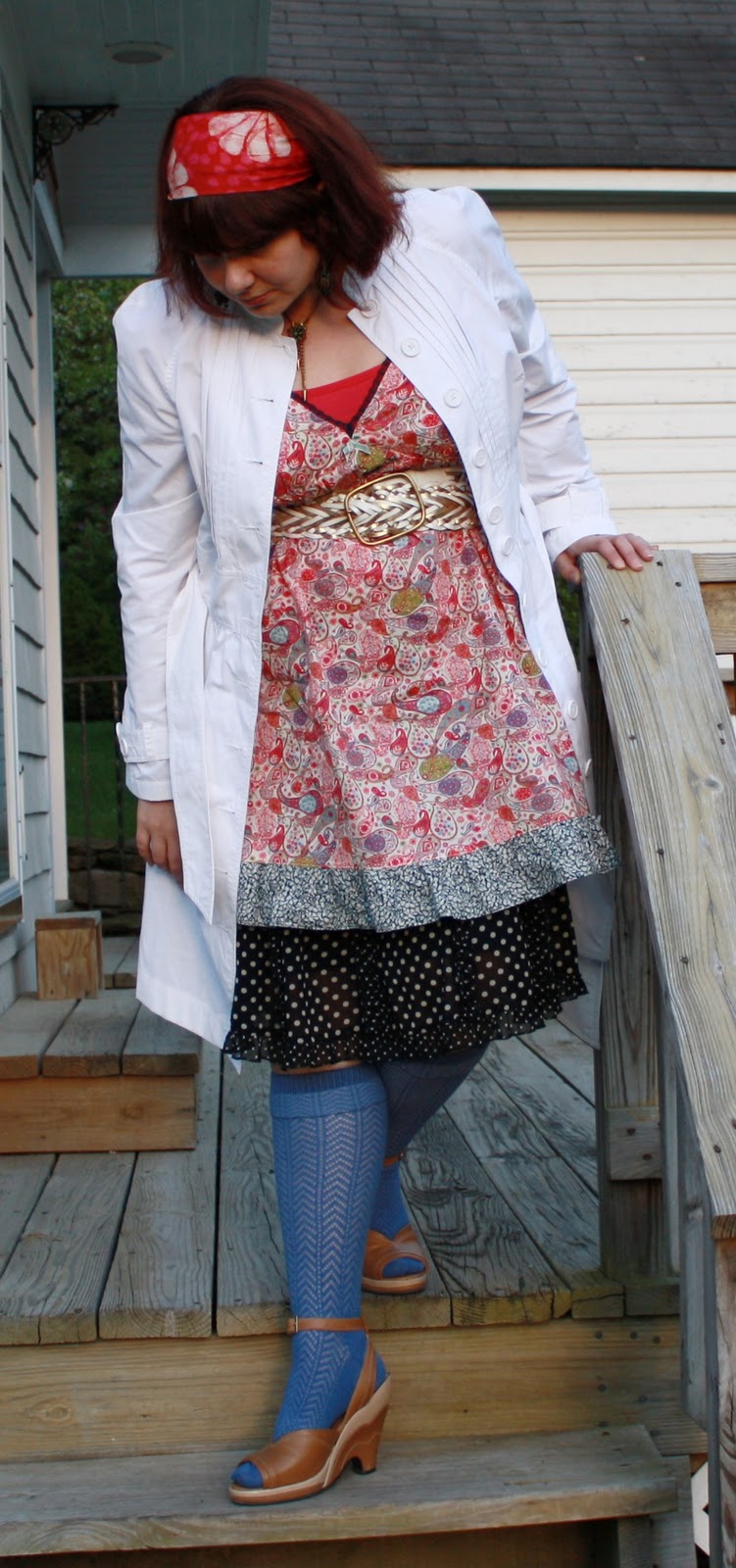
today's outfit, WIWT, Target flowered chemise, Theory tank, skirt, Fluevog shoes, Sock Dreams OTKs, trench coat
Floral chemise: Liberty of London for Target, remixed 
Pink layering tank: Theory, thrifted, remixed
Polka-dot skirt: Ann Taylor Loft
White-and-gold belt: thrifted, remixed
White trench: Daisy Fuentes, thrifted, remixed
OTK socks (cuffed): Sock Dreams "O Chevrons" (discontinued color)
Beige platform shoes: John Fluevog "Pin-ups" (style unknown), remixed
Bronze flower necklace, thrifted, remixed
Bronze and green medallion earrings, gift
Silk scarf (worn as headband): gift from mom

You'd never guess it to look at me today, huh?


In fashion as in many other things in life, I've learned to ignore fear. It can be crippling. I was terrified to blog - afraid I'd meet with derision, that I'd be completely ignored, that crazy Internet stalkers would come out of the woodwork and make my life hell.

Needless to say, none of that has happened. I love every one of you, Fabulous Readers, and I deeply appreciate the wonderful comments you leave - they make me think and they make me feel like I'm part of a community.

closeup, scarf in hair

The only times I've ever gotten anywhere in life are when I've gone out on a limb, swallowed my fear, and taken a metaphorical leap off a cliff. It's scary to walk up to a perfect stranger at all, let alone ask him or her for a favor - but that's how I ended up interning at DC comics while I was doing my BA degree. I saw a guy in a coffee shop wearing a jacket with the DC logo on the back, went up to him, and asked him if he worked for the company. My heart was in my mouth the whole time.

Much to my surprise, he didn't throw his coffee in my face, complain to the manager, or give me a funny look and walk away. We had a nice little chat, and I walked away with a piece of paper scribbled with a name and phone number for a contact in the editorial department. Man, was that a fun semester!

trench and patterned outfit, pattern matching

 This outfit is the same way. There's a lot going on: five or six different patterns, a lot of colors, and some pretty unusual shapes. If I'd played it safe, I'd wear maybe one patterned item at a time - maybe two at the most. But I threw caution to the wind, and I think it turned out pretty OK.

I keep wearing this white trench with the Liberty of London florals, even though I don't like how stoop-shouldered it makes me look (darn raglan seams!). I think I like the clarity of the white in contrast with the busy, intensely colorful prints.

cute socks with sandals

I think the socks and sandals look particularly good together - I love the blue and beige combo, and the laciness of the socks with the solidity of the wedge heel!

What sorts of things do you have to feel bold and daring to wear? What's your "out on a limb" fashion?

08 April 2010

Misled by the weatherman

It's a cliche that style bloggers talk about the weather a lot, and no wonder: in addition to all the other factors that influence how we dress, environment is a huge consideration. Even people who swear they "don't care about how they dress" take heat, humidity and precipitation into account.

So people who think and talk about fashion a lot tend to focus on the weather a bit. We develop a close, personal relationship with out weather forecasters, reacting with jubilation when the weather cooperates with our outfits ("Sunny and warm tomorrow? Hooray, I wanted to wear my new sundress!") and grouchiness when the forecasts interfere with our plans ("Whaddaya mean, rain tomorrow? I wanted to wear my suede boots!) or, worse yet, wrong.

Today, for example, was supposed to be quite a bit cooler than it actually was, so I dressed appropriately:
today's outfit, WIWT, vest, dress, skirt, sandals, pearls
Pinstriped vest: Ann Taylor Loft
Bunny print dress: Erin Fetherston for Target, thrifted
Polka-dot skirt: Ann Taylor Loft
Shoes: John Fluevog, "Summertime" (style uncertain), remixed
Pearls: gift from Fabulous Husband
Alice band: cut-out T-shirt neckband

The dress (lined) plus skirt (also lined) plus vest (you guessed it, lined) was just fine first thing in the morning, but got a little oppressive as the day wore on.
today's outfit, vest, dress, skirt, sandals, flowering plum tree

Despite the climatic inappropriateness, I like the vaguely Victorian carnival feel of this dress and the mix of patterns. Yes, the print on the dress is tiny bunnies! I think I'll revisit this look in cooler weather with fun tights and either a coordinating tee underneath or a nip-waisted blazer over.

today's outfit, WIWT, vest, dress, pearls

Fabulous Husband was offended, on deep, basic levels, by the fact that I didn't have a Set of Pearls. As far as he's concerned, every woman should have some. So while we were out trawling our local antiques store this past weekend, we came across these. I thought they were a bit too big and '50s-housewifeish for my comfort, but he sweet-talked me into them. I'm very glad, and I've become quite fond of them. I like them best in non-traditional combinations, like with this outfit or a military jacket and skinny jeans.

As for the headband, I cut the necklines out of most T-shirts I own: crew necks are just too tight and restrictive, even for the gym! Actually, they're especially bad for the gym: the last thing I want when I'm working up a sweat is a piece of fabric tight around my neck, making me even hotter. I've discovered that the neckbands from T-shirts are the perfect size and just stretchy enough to work as headbands. Why go out any buy special purpose-made ones when I've got some that would otherwise be waste? If you like to trim the sleeves off T-shirts, I've heard they work this way too, at least the more voluminous ones.

So what about you, Fabulous Readers? Has a forecast ever misled you into an outfit that, while otherwise flattering, fell flat because of the weather?

06 April 2010

More layering with dresses

Muggy spring weather and experiments in dress layering continue apace.

today's outfit, WIWT, turquoise bubble-hem dress, white fishnets, green pumps, white and gold belt
Turquoise dress :thrifted
Olive green rib-knit tank: thrifted, remixed
Gold-and-white woven belt: thrifted
White fishnets: depths of the drawer
Green shoes: John Fluevog, "Teapots: Darjeeling," remixed

today's outfit, turquoise bubble-hem dress, white and gold belt
Bronze flower necklace: thrifted
"Turquoise" earrings: mall accessory store (Claire's?)

Up until recently, I loathed turquoise, both the stone and the color. Last year, though, a jeweler friend gave me a fabulous pendant designed to hold a small sphere and a choice of stones to be put in it. Normally I'm a sucker for amethyst, carnelian, hematite, lapis... but in this mix, the one that called to me was an included, brown-streaked piece of turquoise.

I've been in love with the color ever since. 

Now, of course, Pantone has named a shade of turquoise the 2010 color of the year. I haven't figured out if I've developed fashion-related psychic powers, I'm developing into a savvy trendspotter, or it's a wacky coincidence. I'm leaning toward the latter.

My mania for turquoise extended to trying on this dress. Bubble hems are not a look I'd ever thought would flatter me - in fact, I swore up-down-and-sideways at one point that I'd never wear one. However, like every style I've ever sworn I would never in a million years wear, I found one example that I like, and now I'm viewing the entire concept in a whole new light.

today's outfit, turquoise bubble-hem dress, white fishnets, green pumps, white and gold belt

While there's something to be said for having clearly defined stylistic boundaries, I'm enjoying that little revelation. I hear far too many women say "I would never wear..." or "I don't look good in..." or " is a bad one for me..." The more I spend playing with clothes, the more I realize that you should never say never about anything stylistically. I've seen full-figured women rock micro-minis, super-petite women look smashing in floor-length skirts, sallow-complexioned women be stunning in yellow - all things that conventional fashion wisdom says are impossible.

white fishnets, green pumps

Yes, it may take a bit of planning and forethought: a woman who's 5'1" is going to have to work a bit harder to pull off a long skirt than one who's 5'10". A rosy-skinned redhead is going to have to be more selective in picking a shade of pink to wear than a pale-skinned brunette. However, if you really want to wear a style, there is a way to do it and look good.

Have you ever found yourself craving a style or color you'd previously scorned? What about fashion boundaries - do you have anything you simply won't wear? Why or why not?

16 February 2010

Unexpected

This morning, as my husband and I were debating the merits of getting up and getting coffee or just staying in bed all day (He'd been working all night, and we're mid-snowstorm), we got a call from my father. He had some sad news to share: one of my (moderately distant) relatives had died after a long struggle with cancer.

"The funeral's on Thursday," he said.

"I want to go," I said. We don't see that part of the family that often, but some things - like funerals - are Important.

After he'd hung up, the husband and I had a Dreadful Realization: neither of us owns a simple, conservative black suit in our size any more. I'm just a squidge too broad in the beam for my late-'90s Lower Broadway Web Designer suits still, and as for the husband, well, I'm glad he's not skinny enough to wear a 28" waist anymore, but that's the size to which all his suits (from a similar era of master-of-the-universeship) are tailored.

So guess what we're off to do today?

I'm easy. I'm entirely certain that, for under $100, I'll be able to find a good-quality black suit at either TJ Maxx or Marshalls - maybe, if my shopping karma is truly excellent today, I'll snag a $15 Goodwill special. He's going to be a bit harder. Last time I needed to get a men's suit in a hurry, I had Century 21 and Syms in a two-block radius from my office building. Those days are gone, and for the most part, I don't miss them.

Why is it even important?

Deaths, births, marriages, and comings-of-age are lifecycle events - the rituals that mark an individual's change of status in a society. If I wanted to get very Tibetan Buddhist about it, I'd say that they are between states: transitions from one phase to another. Entire books of social theory have been written on why these ceremonies and rituals are important.

To a large extent, modern European/American society has discarded these rituals, or permuted them into something very different than once they were. Pick up a copy of a bridal magazine (Go on, I dare you! Just make sure you do a warm-up set and put on your weight belt first) or go to an over-the-top suburban bar/bat mitzvah and you'll know what I mean.

Funerals are different. For one thing, our society has gotten very out of touch with death. We stave it off, try to deny its existence, are disturbed by its mere mention. In some ways, it's understandable: modern medicine, sanitation, and nutrition have made death a much less frequent occurrence that happens at greater and greater ages. Generally. Infant mortality has never been so low, nor lifespans so long.

But death does come, and, stave it off though we might, it is inevitable: death is the one common experience all living things share. We're not taught the skill set to deal with it gracefully, though. In a way, that's good: we don't know how to deal with it because we encounter it so seldom. When we do, though, it's awkward. We don't know what to say or how to act.

As always, my answer is sartorial. Enter the conservative black suit.

As funeral wear, the conservative black suit (women have options on trousers or knee-length skirt; men, unless they're very Scottish, should most likely stick to trou) serves multiple purposes. It conveys respect, both for the departed and for their grieving loved ones, and it serves as armor and uniform for the equally-bereaved guest.

Armor and uniform. Those are two important things, in trying times.

Uniform because it frees you from the necessity/obligation of too many decisions, at a time when - quite frankly - clothes may be the last thing on your mind. Also, it provides the comfort of solidarity: you and your fellow mourners are dressed in similar ways, and derive an automatic sense of fellow-feeling and support from it. Even if you weren't particularly close to the deceased, your donning of the uniform of mourning shows the bereaved that you are there for them, participating in their sorrow.

Armor - it is amazing how the right clothes can stand between us and the world, us and our emotions. When a dear friend's father died unexpectedly, she later told me, she instinctively reached for her corset: she needed its steel-boned support as a bulwark. Even garments that are less literally armor-like can provide the sense of security and safety that can be elusive during a time of upheaval and dramatic change.

So, as soon as the snow lets up, we're heading out to look. I'm incredulous that I'm so unprepared: for years, it's been my maxim to always have a dark suit ready to go, in case of emergencies. Birth and marriage you can anticipate.

What do you think? Is my insistence on conservative black suits (with non-shiny accessories, natch) for funerals old-fashioned? How do you dress for unexpected sorrowful events, and how does it affect your mood and behavior?

10 February 2010

Letting my guard down

Ah, the problems of being fashion-focused in a small, rural town....

I live in the middle of Horse Country. For all its good points (Wide-open spaces! Fresh air! Beautiful nightly starscapes!) it's not exactly what one would call a fashion mecca. The Horsey Set thinks nothing about pulling off their knee-high riding boots and swanning about town in jodhpurs, sneakers, and disreputable barn coats or fleece jackets. If you've never seen the jodhpurs/sneakers combo, count yourself blessed: it's enough to make this Theorist shudder.

As a result of our town's remarkably casual standards of dress, I'm a lot less on the ball about my appearance for day-to-day trips into town to run errands like picking up mail from the post office or grabbing a few post-blizzard groceries than I would be if I lived in a more fashion-conscious area. I've gotten to be surprisingly OK with running these errands in my gym-going uniform of yoga pants, a fitted tee, and a giant, bright orange L. L. Bean parka that has few fashionable virtues but many practical ones (i.e., it's warm as all get-out and has lots of sizable pockets). To say it's Not Exactly my best look is a mild understatement. Usually, though, that's not a concern: the people I run into in town are dressed similarly, if not even more slubbishly.

workout clothes
Sadly, a close approximation of my normal workout clothes. Unflattering sports bra not pictured.

Unfortunately, yesterday when checking the mail and stocking up on Important Supplies (bourbon and red wine) for the upcoming end-of-the-world caliber snowstorm forecast for today, I ran into not one, but two women sporting absolutely adorable coats. One of them was even wearing a cute denim mini, brightly-colored tights, and cowboy boots. She looked adorable. I looked like a frump.

That's the sort of thing that makes it hard to say "Yeah, I'm a fashion blogger, and I'm trying to make a living as a stylist!"

It's not that I was jealous of her (although I was, a little: did I mention her jacket was really adorable?). It's that I felt I had let both her and myself down. Her, for obviously putting such effort into getting dressed, which I had not reciprocated, and myself, for leaving the house not looking my stylish best - or at least not like a slob. Her cute outfit made my day a little brighter: mine, I'm sure, did not.

I was left feeling a little sad, and not for any conventional reason of inadequacy or jealousy. I wasn't sad that I didn't measure up: I was sad that I hadn't thought to put forth the same effort - it wouldn't have been much - to looking nice instead of slovenly. If I had been on my way to the gym, it would have been different: functional clothing, functional purpose. The gym is the one place where I can let go of the stylistic construction of my body and focus on its sheer formal (form-related, not dressy) significance. I wasn't gymward-bound, though: I went home again before hitting the weight room.

I was sad that I hadn't measured up to my own standards.

I don't think we have an obligation to society to present our best, most polished face to the world every time we leave the house. Down that path lies madness, not to mention putting on mascara to get on the treadmill (if you must, go waterproof). But do we, perhaps, have an obligation to ourselves? Gleeful as I was to see other women walking around my small, unfashionable town looking quite stylish, I came away disappointed because that day, I wasn't one of them.

What are your thoughts? Am I taking myself too seriously? Crossing the line from "image-conscious" into "vain?" Or are my feelings of being caught with my guard down rather reasonable? How much does the prevailing fashion culture of your environment affect you - both how you dress and how you feel about yourself? 

09 February 2010

I hate black trousers

I really do. I loathe them with every fiber of my being.

Why?

The reasons are manifold and complex. For one thing, I resent anything so widely toted as a "fashion basic." I haven't owned a pair of black trousers in ages, but my wardrobe has taken me confidently from corporate boardrooms to dinners out to fancy events to dive bars just fine, thank you very much. I also, unsurprisingly, lack a plain white buttondown shirt, a white tee (although those might be more properly attributed to my tendency, when confronted with a white top, to immediately spill something vividly-colored and staining on it. A model of grace and decorum I am... sporadically), and a pair of black ballet flats (or any flats, really. I find them less comfortable than heels. Honestly!). Many popular "fashion basics" are good building blocks, but I've got enough of an anti-authoritarian streak to look for other alternatives when somebody tells me my life - or my wardrobe - won't be complete without something.

Second is that trousers, in general, are unflattering to the female form. Most women I know have problems finding a pair of trousers that fits them well: if they're not gaping at the back waist, they're whiskering at the crotch, or, worse yet, inflicting a case of the dread polterwang, pulling across the thighs, or hitting at just the wrong spot on the ankle. Or dragging on the ground because they're hemmed for heels and you decided you'd give those insidious, comfort-promising (but actually denying) ballet flats a go. I understand that bifurcated nether garments have a place in a woman's wardrobe. My few pair usually come out in the depth of  winter, when my usual tricks of wool tights, silk longhandles, and leggings under my skirts fail to combat freezing temperatures and invasive winds (eek!). I also, oddly, have made peace with a few pair of jeans, crops (especially ones that hit at just the right point on the calf to show off badass boots), and pantalettes/bloomers (although those get layered under skirts so kind of don't count). However, in general, the complex curves of a woman's lower half are ill-served by mass-produced garments, especially such fit-critical ones with so little to distract the eye from imperfections (in the trousers, silly, not you!). Heck, I'm even fond of trouser alternatives for guys (my husband lives in a kilt all summer and he - and I - could not be happier).

My real beef with black trousers, though, is their blandness. They offend me for the same reasons and in the same way that beige walls and unseasoned farina do: they're dead boring. A really fabulous top, pair of shoes, or accessories can salvage a back-trousers-based outfit, but they're working uphill all the way. Nothing says "I just couldn't be bothered" quite like the stereotypical office-drone uniform of black trousers and a solid-colored blouse or knit top. Actually, most uniforms I've seen have more visual interest.

We live in an era of unprecedented choice and diversity in fashion. Why, then, have so many women wedded themselves to the blandest of the bland?

Let's look at a few examples, shall we?


Here we have a rather adorable, snuggly-looking cowlneck sweater in a bright shade of lemon yellow - the perfect thing to chase away winter doldrums. However, once you pair it with standard-issue black bootleg trousers, there's really not very many places you can go with it: throw on a belt to give your waist some shape and a head out the door. You can't even see the cute, punky strap-and-stud details on your boots!

On the other hand, put on a bluish-purple pencil skirt, and you have a lot more options. The blue scrunch boots would fight with the trouser legs both in color and cut, and wearing a skirt lets you put on raspberry tights.

See how much more vivid the sweater looks paired with the bluish-purple and pink? That's because the colors are in a triadic relationship (That's not nearly as risque as it sounds. Promise). My knowledge of color theory is almost entirely hands-on, so I can't really give you as much how-and-why as I'd like about how it works, but there are several fixed relationships across the color spectrum that result in eye-pleasing combinations: triads are one. Others are complements, tetrads, analogues, and accented analogues. This tool is a great way to get a feel for the way color relationships work, as well as waste quite a few hours (you've been warned).

On to example two!


Now, using that nifty color wheel tool, you've figured out that the best colors to wear with your medium-blue cardigan are purple and turquoise. However, the eye has a long, boring way to travel to unite your colorful pumps - again, mostly hidden by the trouser cuffs - with the rest of the outfit. Swap out the trou for a navy dress, though, and add a pair of purple tights, and you've bridged that gap - plus added a color that has a tonal, or monochromatic, relationship to the original blue.

Let's say you want to wear that other wardrobe basic, the white buttondown shirt:


Even with the admittedly fabulous bittersweet necklace and turquoise belt, the white shirt and black trousers combination is... well, it's a bit staid, isn't it? By changing the black trousers out for a yellow polka-dot skirt (color and pattern, egad!) there's a lot more life to it, especially with the tomato-colored tights.

But Theorist, I hear you beg, what's with all the colors? I've met you, and you're pretty darn Gothy. I prefer, shall we say, more somber colors myself. If the great majority of my ensemble is black, are the black trou really going to make a difference?

Part of the reason I'm featuring so much in the way of vivid color is the medium: black on black really doesn't show up well on the projected light of a monitor. Another part is that, as I mentioned in my last post, this time of year invokes a moderately uncharacteristic yearning for color. This is also the time of year when I start stalking my crocus patch and saying to my long-suffering husband things like "So... how about we repaint the dining room turquoise? With green trim?"

But the black trousers really don't add anything to a work-appropriate gothalicious outfit, either:


Compare these two outfits, both based around an All Saints blouse (I adore All Saints, and if I save my pennies and am a very, very good little Theorist, may someday have one of their gorgeous asymmetrical dresses for my very own). Make your own judgments here, of course, but I think the version with the trumpet skirt, red tights, and chain-draped booties is much more visually interesting, as well as liable to be more figure-flattering to a majority of women.

I guess what it comes down to, for me, is that black trousers are a sartorially safe choice. Like the aforementioned beige walls and unadorned farina, there's nothing in there to upset anyone. If there's one thing I would like to inspire you, my Fabulous Readers to do, it is to dress bravely. I don't mean runway-fashion bravely, or over-the-top-costume bravely: choose simple, quiet acts of bravery in your daily dress choices.


That's a whole 'nother post all on its own, though. Until then, I want to hear your thoughts. Am I off base about the black trou? Are they really a vital part of a woman's wardrobe? Do you love yours to death, and own a dozen pair? Could you go a week without wearing a pair (assuming you work in an office/professional environment)? How about a month? Is my mad passion for skirts getting out of hand?

13 November 2009

Target vs. Walmart

My spousal unit found this conversation, ostensibly held between two women at a bus stop, on a message board to which he belongs. Whether it's apocryphal or not, it says some interesting things about the way our society perceives things, doesn't it?

Woman 1: Yeah, I like Walmart because I don't have to get all dressed up to go there.
Woman 2: Right, it's not like going to Target or something.

Wow.

This raises a lot of questions. I'm going to gloss over the "why is getting dressed up to go shopping such an unpleasant concept/who really feels the need to get dressed up to shop at a discount retailer anyway?" dichotomy, hold any and all speculation about what getting dressed up might entail for these women (all thoughts of People of Walmart held firmly in abeyance), and get right into what I feel is the meat of it: the perceived difference between Target and Walmart.

As a disclaimer, I should say that I've never shopped at Walmart: there isn't one located conveniently near my home, and I have some ethical issues with the company's business practices. I'll try to set those aside, though, in interest of as fair and valid exploration of the subject as I can muster.

Viewed objectively, the two stores are pretty similar: they're large (both in size and distribution) discount retailers, not really department stores in the original sense of the word, but offering a vast breadth of products, from housewares to clothing to pharmacies and even, in some cases, groceries. Walmart has a bit of a nastier reputation in terms of how it treats employees, suppliers, and communities, but neither one is above reproach on that front.

In terms of fashion, Target has launched successful and well-publicized collaborations with designers both well-established and fledgling, including boldface names like Alexander McQueen and Anna Sui. It's even managed to get shoppers to forget that they're buying clothes manufactured to Target's fast-fashion standards and pay near-stratospheric prices for the store (McQueen's line topped out at $129 - which sounds cheap for a designer item, but is steep for anything at Target). Walmart, on the other hand, has teamed up with designers like Max Azria and Norma Kamali, keeping the price points in line with its other clothing offerings. The items are there, they haven't flopped like previous Walmart ventures into designer-driven fashion, but neither are they as well-publicized as Target's. It doesn't even really feel like Walmart's heart is in promoting its own merchandise in this arena: A search for "Target designer collaboration" turns up hits from Target's site first thing, while similar ones for "Walmart designer collaboration" or "Walmart designer collection" don't even turn up clothing-related links to walmart.com on the first page.

I'm still trying to quantify the huge difference between the two stores - why it's acceptable to go to one store in your jammies and the other requires 'dressing up.' Could that advertising and promotion disparity really be the heart of it?

I'm not going to go delving into the intricacies of marketing theory and design, but I will go this far: just as our clothes are the primary message we present to the world around us, ads and marketing are a retailer's. Just as you don't need to interact with a person to interpret the messages sent by their clothes, you don't need to shop at a retailer to interpret the messages in their ads.

I'm also not going to sit here for hours watching ads for both stores for you, Fabulous Readers, not even in the name of research. I don't own a TV for a reason. I will, however, make some generalized conclusions based on the ads I have seen.

Target emphasizes style first; affordability comes in a close second, but second nonetheless. Their ads have a striking modern sensibility, and they seem to focus on fresh, urban looks. Trendy clothes and home merchandise are prominently featured on its Web site: popular fashion options are easily accessible from the home page, and take up almost as much screen real estate as other shopping categories.

Walmart, on the other hand, sells itself on its low price points, and, as we have seen above, places very little emphasis on the stylishness of its products. Its current slogan is "Save money. Live better." My financial advisor agrees with this advice, but I think he's talking more about mutual funds than cut-price electronics - which, from its home page, appears to be Walmart's primary offering. If you want fashion, have fun finding it - all 'apparel' options are squished into a tiny corner of the page.

So, lacking other evidence, I'm going to guess that's it: the attitude toward the two stores evinced by those two loath-to-get-dressed ladies at the bus stop may, in fact, stem from the attitude of the stores themselves. Where can we get if we extrapolate from that?

30 October 2009

Clothed vs. dressed

An astute Fabulous Reader points out that the title's a bit of a misnomer:
I beg to differ :) Everyone puts on clothes. Not everyone "gets dressed." I put on clothes most mornings. Getting dressed -- a mere step away from the coveted getting dressed UP -- is another matter entirely.
and, on some level, I can't help but agree. There are mornings when I'll grab the first articles of clothing that provide sufficient coverage and warmth for the season, and others when I spend hours obsessing over The Perfect Outfit.

However, I can't fully agree. I think that, except in a few very certain circumstances, there's an aspect of selection involved in what we wear, although it might not necessarily happen at the moment when those fibers hit our bodies.

For example, I know a gentleman who often has to rise before his wife. In an ongoing act of true selflessness, he has carefully selected his wardrobe so that every piece coordinates with every other and he can literally get dressed in the dark without waking her. Now, obviously, as he dresses by Braille each morning, he's not making any deliberate choice as to his appearance for the day. The choice was made at an earlier point, but it was still a deliberate, well-thought-out decision.

Then, too, there's what I like to call the "meh" factor. Apathy is a choice too. Not every decision has to be a good one, a well-thought-out one, or even a particularly conscious one. With the exception of gifts, though, most of us have to make some decision regarding getting a new item of clothing into our wardrobes: we have to go to the store, select an item, and pay for it. Even if that choice is one of desperation (ever gone swimsuit shopping, or needed a particular type of outfit on very short notice?) or is, in the eyes of society at large, a bad choice, it's a choice. Sometimes, the statement our clothes make is "I can't be bothered about my clothes."

What do you think? Is there a functional difference between getting dressed and putting on clothes, or are they just degrees of choice and concern? Is it possible to put on clothing without putting any thought into it at all, or is some element of decision-making inherently present, lest we inadvertently leave the house without trousers? Thoughtful and polite comments are always welcome!