Last week, Worn Through featured an article by Tove Hermanson entitled "Festishizing Military Gear." It's a great piece, and I can't fault Ms. Hermanson's conclusion that sexualizing the horrors of war is unacceptable. However, I'm not entirely certain that the prevalence of military gear in fashion is a result of the fetishizing of war, per se: rather, it represents an ongoing fascination with the uniformed body.
There's a lot of history behind militaria in fashion. Just about as soon as people started making armor, it became not only a statement of power, but one of style. Ancient Greek artifacts show arms and armor decorated with beautiful motifs: Roman senators and emperors were depicted in their armor on coinage and in statuary.
By the later Middle Ages and early Renaissance, it became the norm for men to combine pieces of their garnitures, or suits of armor, with their softer, fancier 'street' clothes for portraiture. Not surprisingly, the clothing worn by even unarmored men began to resemble the padded, segmented garments worn for protection under the heavy metal harnesses. So, to an extent, did those of women: some fashion historians theorize that the rise of the corseted female body, which began in this period, was an adaptation of the structured, armored male torso.
Borrowing from military styles has been an integral part of fashion ever since. In the late 1700s, women wore Spencer jackets, often decorated with epaulets, braid, and other ornaments of the era's military insignia, over their diaphanous Empire-waisted gowns. Cardigans were the innovation of a British commander during the Crimean War. Khakis, trench coats, duffel bags, Breton stripes, and other perennial fashion favorites are all of military origin.
Fashion has always had an uneasy attraction to the concept of uniform. Dress, in our society, is supposed to be a means of self-expression, which is an antithesis of the concept of the uniform. However, fashion itself represents a type of uniform: What's in style this season? What looks are the designers showing? Very few people dress with true individuality.
Uniform goes deeper still. All individuality is, in theory, subsumed into the uniformed whole. What this means in practice is that any expressions of individuality lie in two fields: the manner in which the uniform is worn and the body inside it.
It's the second factor, I think, that is one cause of fashion's ongoing fascination with uniforms and militaria. The only time a uniformed individual is able to show his or her individuality is when the uniform is removed. There's an inherent eroticism in the concept that, in order to have the freedom of expression that we consider a necessary component of personhood, the uniformed individual must be unclothed.
If the fetishizing of uniform was entirely about glorifying war, why would other uniform images - schoolgirls, nurses, even clergy - have such a strong presence in fashion and erotica both?
Another contributing factor is the growing casualness of dress in our society. Uniform, in many cases, indicates a more formal mode of dress, or at least the possibility of its existence. Even in work clothes, though, military clothing hints at the possibility of greater formality: the most tattered-looking soldier has a formal dress uniform somewhere.
A quote from a vintage pattern seller featured on Gertie's New Blog for Better Sewing made me think about the power and authority of formal uniform: "The hat, the crisply starched white dresses, the white shoes that nurses used to wear commanded respect. The nurse's uniforms conveyed an authority that the sloppy scrubs with teddy bears that many nurses wear today do not." In many professions, the uniform is now a polo shirt in company colors: crisp shirts and ties have fallen by the wayside. That's not the case in the military, one of the few truly uniformed institutions remaining in our society. Adapting the trappings of the military allows the wearer to borrow a little bit of the perceived power and authority of the uniformed soldier - an interesting dichotomy, because in many situations, soldiers themselves have less say in their career paths, living arrangements, and, obviously, dress, than the non-military person adapting military imagery.
The dress regulations of the US Army fill a book of not inconsiderable size. In any circumstance, a soldier has guidance and direction as to what to wear and how. How many of us, when faced with the welter of choices presented by fashion's conflicting messages, haven't wished for that sort of guidance, even if just for a moment? The popularity of, and fascination with, capsule wardrobe challenges and The Uniform Project among style bloggers indicate that the concept of a limited, dictated wardrobe has appeal, even - perhaps especially - among people who are immersed in the culture of self-expression through fashion.
Separating the uniformed soldier from the war is a fine line: perhaps it's an imaginary one. My perspective on this matter is not unbiased - I'm married to a US Army veteran, which colors my understanding of the military. However, I think that saying that militaria in fashion is little more than a glorification of war sells both fashion and the military sadly short.
Showing posts with label thinking about clothes. Show all posts
Showing posts with label thinking about clothes. Show all posts
01 June 2010


10 May 2010
Living through clothes
I just came across this article in the New York Times' Arts section. It's about an art installation currently being erected in New York City's Park Avenue Armory. The artist, Christian Boltanksi, has assembled the piece from a giant crane, 30 tons of used clothes, 3,000 cookie tins, and a recording of human heartbeats. The clothes are arranged in a giant pile: at intervals, the crane plucks a clump from the pile and scatters it. The cookie tins form a giant wall, sheltering and concealing the installation. The heartbeats are a constant soundtrack - visitors can even record their own beats to add to the track.
The article examines the work in terms of its context of mortality and loss. Using piles of discarded clothing as a signifier of the dead is not a new concept - perhaps the most striking example is the pile of shoes collected from victims at Auschwitz. As a frequent shopper at thrift stores, garage sales, and even estate sales, I know that clothes can be one of the most visceral, intimate reminders of the departed. Perhaps only scent carries more freight, emotionally.
However, I wonder if there's another interpretation that can be put on this work - one not of mortality and loss but of consumption and consumerism.
Thirty tons of used clothes. Let's say that again. Let's do a little experiment.
I put together a moderately representative outfit: jeans, socks, a blazer, a hoodie, a tee, and a tank. I deliberately chose a mix of heavier and lighter items. I didn't include shoes because the article specifially mentioned clothes only, and didn't bother with underwear in the theory that even the most massive bra weighs only a few ounces.
The pile of six items weighed about seven pounds. I'm willing to round that up to 10 pounds, for argument's sake and to make the math easier. So if we figure every 10 pounds is approximately six items of clothing, one ton (2,000 pounds) is 1,200 items; 30 tons is 36,000 items. Thirty-six thousand pieces of clothing (give or take a few hundred, I'm sure) that people bought, wore, and then eliminated from their closets.
For contrast, the Metropolitan Museum of Art has over 35,000 pieces in their costume collection, while the Victoria and Albert Museum has "14,000 outfits plus accessories."
Some of those items may come from the deceased, but I'm willing to bet (although there's no way to confirm this, really) that most came from living people who just decided they didn't want those pieces of clothing any more.
Now, these clothes came from a textile recycling plant, which maybe - hopefully - means that they were in such poor condition that they couldn't be resold. It also means that they were slated for re-use, rather than disposal, before they got pegged to become part of a major art installation.
Looking at it, I must admit I think more about our society's patterns of use and waste, of the cycle of accumulating and then discarding material possessions, than I do about the fragile nature of life. The random scattering of the clothing pile, in particular, makes me think of the often arbitrary nature of fashion trends. It reminds me of the way my own floor looks after the frantic search for an outfit that works on one of those days where nothing seems to fit or work together right - piles of discarded clothes that I disconsolately pick up, fidget with for a while, then discard into a different pile. I'm also reminded that being fashionable and amassing a wardrobe can easily turn from an enjoyable pursuit into an obsession, and, like any obsession, leave you hollow and devoid of meaning, an empty building full of a pile of discarded clothes.
In some ways, that makes it even more melancholy than its original intent.
I also kind of wonder who ate all the cookies that came in those tins.
Regular outfit posts will resume (hopefully) later today.
The article examines the work in terms of its context of mortality and loss. Using piles of discarded clothing as a signifier of the dead is not a new concept - perhaps the most striking example is the pile of shoes collected from victims at Auschwitz. As a frequent shopper at thrift stores, garage sales, and even estate sales, I know that clothes can be one of the most visceral, intimate reminders of the departed. Perhaps only scent carries more freight, emotionally.
However, I wonder if there's another interpretation that can be put on this work - one not of mortality and loss but of consumption and consumerism.
Thirty tons of used clothes. Let's say that again. Let's do a little experiment.
I put together a moderately representative outfit: jeans, socks, a blazer, a hoodie, a tee, and a tank. I deliberately chose a mix of heavier and lighter items. I didn't include shoes because the article specifially mentioned clothes only, and didn't bother with underwear in the theory that even the most massive bra weighs only a few ounces.
The pile of six items weighed about seven pounds. I'm willing to round that up to 10 pounds, for argument's sake and to make the math easier. So if we figure every 10 pounds is approximately six items of clothing, one ton (2,000 pounds) is 1,200 items; 30 tons is 36,000 items. Thirty-six thousand pieces of clothing (give or take a few hundred, I'm sure) that people bought, wore, and then eliminated from their closets.
For contrast, the Metropolitan Museum of Art has over 35,000 pieces in their costume collection, while the Victoria and Albert Museum has "14,000 outfits plus accessories."
Some of those items may come from the deceased, but I'm willing to bet (although there's no way to confirm this, really) that most came from living people who just decided they didn't want those pieces of clothing any more.
Now, these clothes came from a textile recycling plant, which maybe - hopefully - means that they were in such poor condition that they couldn't be resold. It also means that they were slated for re-use, rather than disposal, before they got pegged to become part of a major art installation.
Looking at it, I must admit I think more about our society's patterns of use and waste, of the cycle of accumulating and then discarding material possessions, than I do about the fragile nature of life. The random scattering of the clothing pile, in particular, makes me think of the often arbitrary nature of fashion trends. It reminds me of the way my own floor looks after the frantic search for an outfit that works on one of those days where nothing seems to fit or work together right - piles of discarded clothes that I disconsolately pick up, fidget with for a while, then discard into a different pile. I'm also reminded that being fashionable and amassing a wardrobe can easily turn from an enjoyable pursuit into an obsession, and, like any obsession, leave you hollow and devoid of meaning, an empty building full of a pile of discarded clothes.
In some ways, that makes it even more melancholy than its original intent.
I also kind of wonder who ate all the cookies that came in those tins.
Regular outfit posts will resume (hopefully) later today.
21 April 2010
The Cure for a Bad Mood
Something I read online today made me very grouchy, so I decided I needed to cheer myself up with a fun outfit.

Plus, after three days spent in grubby construction clothes, I wanted to wear something feminine. There's nothing wrong with my grubbies, and I love working with Fabulous Husband to build new things and maintain our 130-year-old house, but after a few days in the same raggedy, sawdust-crusted jeans, I'm ready for a change of pace.
For whatever reason, crinolines have always put me in a good mood. They're so fluffy and effervescent: it's very difficult to be cranky when wearing one!
More importantly, they're fun to move in:

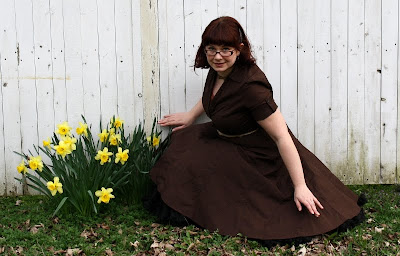
For you language historians out there, the term "frou-frou" actually originates from the long silk organza petticoats popular in the Edwardian era. It's an onomatopoeia: Frou-frou is the rustling sound a stiff silk petticoat makes when you walk in it. This shorter nylon one doesn't make the noise, but it does make my skirt amusingly voluminous. It's an unusual feeling, having the widest part on my body be somewhere around mid-calf level.
Part of the appeal of this outfit is its vintage styling. Fabulous Husband and I watched Julie and Julia last night (a wonderfully amusing movie - and that's coming from both of us). A few things struck me, especially about Julia Child. Firstly, despite the well-known repression and lack of opportunities available to women in the mid-20th century, there wasn't much that stood in her way from doing anything she damn well wanted to do - and doing so while wearing put-together ensembles, including heels and skirts. Forget the old chestnut about Ginger Rogers doing everything Fred Astaire did, only backwards and in high heels: Julia Child did everything her fellow (male) students did in, but skirts and heels. Anyone who's ever spent any amount of time in a restaurant kitchen knows how trying that could be!

The other thing that struck me was Julia's unflagging optimism and good spirits. Did she get upset about things, angry, depressed? Absolutely. Everybody does. Instead of letting things that upset or angered her throw her, though, Julia reacted with good cheer and a make-the-best-of-it attitude. I don't know how true to life Meryl Streep's portrayal of Julia Child was, but I got the distinct feeling that this was less a natural trait than a carefully cultivated determination to find the silver lining in any cloud, no matter how stormy.
That's an attitude I'm going to try to cultivate myself. Hence the crinoline.
 This is prior to finishing: we put our shoes on it (No, those aren't all mine! Some of them belong to Fabulous Husband!) and put it in place on a trial run basis. It'll get a coat of golden oak stain, to match the rest of the room, and then several of spar varnish, for durability. It may not be the most elegant piece of furniture ever, but it's far superior to our previous heap-on-the-floor "storage" system.
What do you do to cheer yourself up when you get down? Does the way you're dressed help? Do you have some pieces of clothing that makes it impossible (or very difficult) to feel grouchy while you're wearing it?

Brown shirtdress, Ann Taylor Loft
Hand-dyed silk tank, Reyen Design Studios
Belt, thrifted
Crinoline, thrifted
Shoes, John Fluevog, "Mini: Qtee"
 Buckle necklace: estate sale
Tiny skull earrings: assembled myself: skull charms of uncertain origins
photos: Fabulous Husband

Tiny skull earrings: assembled myself: skull charms of uncertain origins
photos: Fabulous Husband
Plus, after three days spent in grubby construction clothes, I wanted to wear something feminine. There's nothing wrong with my grubbies, and I love working with Fabulous Husband to build new things and maintain our 130-year-old house, but after a few days in the same raggedy, sawdust-crusted jeans, I'm ready for a change of pace.
For whatever reason, crinolines have always put me in a good mood. They're so fluffy and effervescent: it's very difficult to be cranky when wearing one!
More importantly, they're fun to move in:


For you language historians out there, the term "frou-frou" actually originates from the long silk organza petticoats popular in the Edwardian era. It's an onomatopoeia: Frou-frou is the rustling sound a stiff silk petticoat makes when you walk in it. This shorter nylon one doesn't make the noise, but it does make my skirt amusingly voluminous. It's an unusual feeling, having the widest part on my body be somewhere around mid-calf level.
Part of the appeal of this outfit is its vintage styling. Fabulous Husband and I watched Julie and Julia last night (a wonderfully amusing movie - and that's coming from both of us). A few things struck me, especially about Julia Child. Firstly, despite the well-known repression and lack of opportunities available to women in the mid-20th century, there wasn't much that stood in her way from doing anything she damn well wanted to do - and doing so while wearing put-together ensembles, including heels and skirts. Forget the old chestnut about Ginger Rogers doing everything Fred Astaire did, only backwards and in high heels: Julia Child did everything her fellow (male) students did in, but skirts and heels. Anyone who's ever spent any amount of time in a restaurant kitchen knows how trying that could be!

Well, unless they were these heels. These things feel like sneakers!
The other thing that struck me was Julia's unflagging optimism and good spirits. Did she get upset about things, angry, depressed? Absolutely. Everybody does. Instead of letting things that upset or angered her throw her, though, Julia reacted with good cheer and a make-the-best-of-it attitude. I don't know how true to life Meryl Streep's portrayal of Julia Child was, but I got the distinct feeling that this was less a natural trait than a carefully cultivated determination to find the silver lining in any cloud, no matter how stormy.
That's an attitude I'm going to try to cultivate myself. Hence the crinoline.
Oh, and for those of you who were curious, the shoe rack progresses.

What do you do to cheer yourself up when you get down? Does the way you're dressed help? Do you have some pieces of clothing that makes it impossible (or very difficult) to feel grouchy while you're wearing it?
19 April 2010
A construction project and a shopping ban
EarthNo outfit pictures today, Fabulous Readers. I spent all day in my grubby jeans, a beat-up tee, and steel-toed boots, a schmatteh on my head - not a pretty picture and nothing that needs to be recorded for posterity!
Why?
I've gotten tired of not having a storage solution for all my shoes.
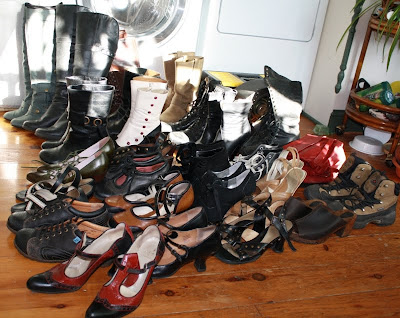
Man, that's a lot of shoes. I've never really laid them out in one place before, or counted them. Turns out I have 17(!) pairs of Fluevogs; boots from United Nude, Frye, Earth, Ecco, and Underground; shoes from Me Too and Tahari; and, of course, the canonic Converse Chuck Taylor All-Star hightops. Sad thing is, that's not all of them: I didn't bother putting my gym sneakers, Merrel mocs, Wellies, or flip-flops in the picture (I don't consider them to be real shoes!), and my Fluevog Summertime Haights are at the cobbler's getting a tune-up.
I've gotten really sick of having them underfoot, getting kicked around and damaged. Even if I assume an average value of $100 (which is a bit low... the Chucks might only have cost me $20 at TJMaxx, but a few of the 'Vogs were closer to $400), that picture represents approximately a $2500 investment, or, as I like to think about it, seven graduate-level credits, over 300 burritos at my favorite local Mexican joint, or an entire new wardrobe or two at Goodwill. I figure they're worth taking good care of.
I've never been able to find a shoe rack that I liked, so I recruited Fabulous Husband to help me build one. One trip to Lowe's, some quick-and-dirty education in the use of various power tools (Fabulous Husband was quite clear on the fact that this was my project and that I would build it, although he was happy to offer assistance and much-needed advice), and a whole lot of sawdust later, I have the bones of what I hope will be an effective storage solution: a 45" tall, 4' wide, 5-shelf system that should not only hold everything pictured here but a few extras. It's clamped together in the garage now, and if everything goes according to plan, I should have an awesome custom shoe rack, stained to match the other pieces in that room, by the end of the week!
Part of the reason I'm working on this is that I've put myself under a month-long personal shopping ban (I actually started on 15 April, but somehow managed not to write about it until now). I could say it's to decrease my reliance on consumerism or to be more conscious of my spending habits - but no, really, it's because International Fluevog Day is 15 May, and I want to save my pennies for the big extravaganza that an inside source has promised will ensue. I'm allowing myself one holiday from the ban: Spoutwood Faerie Festival in Glen Rock, PA, which Fabulous Husband and I attend every year with our wonderful friends David and Dorita from Reyen Design Studios. It's a once-a-year opportunity, so I'm not going to hold myself to rules too tightly there. Other than that, I'm being strict: no clothes, no shoes, no bath and body products. Food's still OK. Stuff for the house is a subject for deep philosophical debate.
It's interesting, though - after just a few days, I'm amazed at how much time I'm not spending browsing online shopping sites (on the out of sight, out of mind theory), and at how much recreational value I usually derive from going shopping in various forms. I'll keep posting about my thoughts and feelings about this!
Oh, and apologies to everyone who gets posts through an RSS reader: this post published prematurely (I don't even know what I did!), so if there's something wonky in your feed, it's my fault, and I'm very sorry.
Why?
I've gotten tired of not having a storage solution for all my shoes.

Man, that's a lot of shoes. I've never really laid them out in one place before, or counted them. Turns out I have 17(!) pairs of Fluevogs; boots from United Nude, Frye, Earth, Ecco, and Underground; shoes from Me Too and Tahari; and, of course, the canonic Converse Chuck Taylor All-Star hightops. Sad thing is, that's not all of them: I didn't bother putting my gym sneakers, Merrel mocs, Wellies, or flip-flops in the picture (I don't consider them to be real shoes!), and my Fluevog Summertime Haights are at the cobbler's getting a tune-up.
I've gotten really sick of having them underfoot, getting kicked around and damaged. Even if I assume an average value of $100 (which is a bit low... the Chucks might only have cost me $20 at TJMaxx, but a few of the 'Vogs were closer to $400), that picture represents approximately a $2500 investment, or, as I like to think about it, seven graduate-level credits, over 300 burritos at my favorite local Mexican joint, or an entire new wardrobe or two at Goodwill. I figure they're worth taking good care of.
I've never been able to find a shoe rack that I liked, so I recruited Fabulous Husband to help me build one. One trip to Lowe's, some quick-and-dirty education in the use of various power tools (Fabulous Husband was quite clear on the fact that this was my project and that I would build it, although he was happy to offer assistance and much-needed advice), and a whole lot of sawdust later, I have the bones of what I hope will be an effective storage solution: a 45" tall, 4' wide, 5-shelf system that should not only hold everything pictured here but a few extras. It's clamped together in the garage now, and if everything goes according to plan, I should have an awesome custom shoe rack, stained to match the other pieces in that room, by the end of the week!
Part of the reason I'm working on this is that I've put myself under a month-long personal shopping ban (I actually started on 15 April, but somehow managed not to write about it until now). I could say it's to decrease my reliance on consumerism or to be more conscious of my spending habits - but no, really, it's because International Fluevog Day is 15 May, and I want to save my pennies for the big extravaganza that an inside source has promised will ensue. I'm allowing myself one holiday from the ban: Spoutwood Faerie Festival in Glen Rock, PA, which Fabulous Husband and I attend every year with our wonderful friends David and Dorita from Reyen Design Studios. It's a once-a-year opportunity, so I'm not going to hold myself to rules too tightly there. Other than that, I'm being strict: no clothes, no shoes, no bath and body products. Food's still OK. Stuff for the house is a subject for deep philosophical debate.
It's interesting, though - after just a few days, I'm amazed at how much time I'm not spending browsing online shopping sites (on the out of sight, out of mind theory), and at how much recreational value I usually derive from going shopping in various forms. I'll keep posting about my thoughts and feelings about this!
Oh, and apologies to everyone who gets posts through an RSS reader: this post published prematurely (I don't even know what I did!), so if there's something wonky in your feed, it's my fault, and I'm very sorry.
15 April 2010
Rockabilly
I woke up this moring knowing that I wanted to wear these socks and shoes together:

I didn't know what I wanted to wear with them, mind you, just that I wanted to experiment with this look. I'm usually not that fond of any sock shorter than knee-length, so these delicate little anklets are a standout in my sock drawer. I never wear them. So I figured that the last nice, sunny day for a while merited an opportunity for them to see the light of day.
I pulled out a flower-embroidered linen skirt, the background fabric the same color as the socks. I layered it over a black lacy skirt to keep it from looking too sweet. I put my favorite black lace-trimmed cardigan over my favorite pink long-sleeved tee. I tried three different belts. None of it worked!
In desperation, I pulled off the first skirt and tried this floral sheath dress instead. A-ha, now we were getting somewhere! I ditched the lacy underskirt (too much bulk under the slim dress), pulled the cardi back on, and realized I was developing a very late-Fifties/early Sixties look: sheath dress, cardigan, chunky heels. The pyramid studs on the shoes kept it from being too sweet, adding a little rock-and-roll flair.
What do you get when you mix midcentury styles with modern rock sensibilities? Rockabilly! Well, an interpretation of it, anyway.
I decided to play up the look, taking it almost-but-not-quite to the verge of costume with a wide headband, studded cinch belt, pearls, and petite frame purse:

I love that little bag. It's cute, surprisingly capacious, and oddly era-neutral. It works with this very midcentury ensemble, but I've also strung a few antique keys onto one handle (hanging over the bow) and worn it with Victorian-influenced steampunk outfits.
I kept the makeup in tune with the clothes: a relatively neutral palette, a strong winged eye, and pale, frosted lips. I know most rockabilly girls prefer va-va-voom reds, but for daywear, and an outfit more influenced by the late Fifties and early Sixties than the Forties and early Fifties, I thought the pink was a better fit.

Throughout the day, I found myself adapting the movements and gestures I've seen in movies from the era this outfit hearkens to. Some of it was the dress: it's structured, so I can't slouch too much; it's got a narrow hem, so I take shorter steps; the skirt rides up alarmingly if I'm not cautious, so I watch myself getting into and out of cars (there's a technique to getting in and out of a car in a short skirt) and cross my legs at the ankle instead of the knee or not at all. Some of it, though, was more studied: it felt right to hold my purse in front of me, both hands on the straps (almost like a kettleball) while standing, for example. I'm not sure if that was a hint of old acting training, urging me to fall into the 'character' this outfit created, or if those gestures, too, were created by the clothes and their relation to the body, just less obviously.
Oh, and I was pretty happy with the socks-and-sandals effect. I think, just like tights and sandals, it might depend heavily on the specific items being combined to work. I'm going to continue to experiment.
How does your clothing affect your movement, gestures, and body language? If it does, is it strictly functional, or do you find yourself creating characters with your outfits and then matching your body language to them?

Shoes, John Fluevog "Summertime," style unknown, remixed
Socks, depths of the drawer
I didn't know what I wanted to wear with them, mind you, just that I wanted to experiment with this look. I'm usually not that fond of any sock shorter than knee-length, so these delicate little anklets are a standout in my sock drawer. I never wear them. So I figured that the last nice, sunny day for a while merited an opportunity for them to see the light of day.
I pulled out a flower-embroidered linen skirt, the background fabric the same color as the socks. I layered it over a black lacy skirt to keep it from looking too sweet. I put my favorite black lace-trimmed cardigan over my favorite pink long-sleeved tee. I tried three different belts. None of it worked!
In desperation, I pulled off the first skirt and tried this floral sheath dress instead. A-ha, now we were getting somewhere! I ditched the lacy underskirt (too much bulk under the slim dress), pulled the cardi back on, and realized I was developing a very late-Fifties/early Sixties look: sheath dress, cardigan, chunky heels. The pyramid studs on the shoes kept it from being too sweet, adding a little rock-and-roll flair.
What do you get when you mix midcentury styles with modern rock sensibilities? Rockabilly! Well, an interpretation of it, anyway.
I decided to play up the look, taking it almost-but-not-quite to the verge of costume with a wide headband, studded cinch belt, pearls, and petite frame purse:

Dress, Liberty of London for Target, remixed
Cardigan, Heart Moon Star, remixed
Belt, Betsey Johnson, TJMaxx, remixed
Pearls, gift from Fabulous Husband, remixed
Purse, Ann Taylor Loft
Headband, Sephora
Headband, Sephora
I love that little bag. It's cute, surprisingly capacious, and oddly era-neutral. It works with this very midcentury ensemble, but I've also strung a few antique keys onto one handle (hanging over the bow) and worn it with Victorian-influenced steampunk outfits.
I kept the makeup in tune with the clothes: a relatively neutral palette, a strong winged eye, and pale, frosted lips. I know most rockabilly girls prefer va-va-voom reds, but for daywear, and an outfit more influenced by the late Fifties and early Sixties than the Forties and early Fifties, I thought the pink was a better fit.

Throughout the day, I found myself adapting the movements and gestures I've seen in movies from the era this outfit hearkens to. Some of it was the dress: it's structured, so I can't slouch too much; it's got a narrow hem, so I take shorter steps; the skirt rides up alarmingly if I'm not cautious, so I watch myself getting into and out of cars (there's a technique to getting in and out of a car in a short skirt) and cross my legs at the ankle instead of the knee or not at all. Some of it, though, was more studied: it felt right to hold my purse in front of me, both hands on the straps (almost like a kettleball) while standing, for example. I'm not sure if that was a hint of old acting training, urging me to fall into the 'character' this outfit created, or if those gestures, too, were created by the clothes and their relation to the body, just less obviously.
Oh, and I was pretty happy with the socks-and-sandals effect. I think, just like tights and sandals, it might depend heavily on the specific items being combined to work. I'm going to continue to experiment.
How does your clothing affect your movement, gestures, and body language? If it does, is it strictly functional, or do you find yourself creating characters with your outfits and then matching your body language to them?
23 February 2010
Lacking inspiration
I'm a big advocate of putting on presentable clothes even if I'm going to be working from home or running basic errands. I end up very upset with myself when I don't.
Today... well today was one of those days where I really didn't want to. After nearly a week of inspiring, invigorating springlike temperatures, I woke up today to a persistent snowstorm, achy muscles from a vigorous workout last night, and a general lack of vim and/or vigor.
Great lead-in to my first ever outfit post, isn't it?

Green dolman top, Michael Kors (via Marshalls)
Green shadow-stripe tee, Urban Outfitters
Gap jeans, Housing Works
Frye Harness 12R boots, Century 21
Rough amethyst necklace, Metropolitan Museum Store
Longer amethyst and clear quartz necklace, gift from mum?
Green webbing belt, thrifted
Coffee mugs, Elan Pottery
Forcing myself to get dressed, even just in jeans and a cute, comfy top (and, natch, making coffee) helped my mood immensely. Green and purple are one of my favorite color combinations: I'll explain how I discovered it soon!
I've talked a lot about how what you wear affects others' impression of you. Clothing is costume: we use it to create a persona that we project to the world. That's not news. What I haven't really spoken about is the internalizing of this effect. While it's very possible to feel utterly lousy about yourself while you're nicely dressed, I find it much easier to feel good about myself when I'm wearing something that I think flatters me and feels put together.
I'm not about to turn into a mascara-on-the-treadmill kind of girl, or even a FlyLady fanatic, but I think that wearing what I perceive of as "real" clothes (gym clothes aren't real clothes: nor are pajama pants) makes me feel better and even think better as well as look better. Yes, I find it easier to write when I'm wearing the sort of clothes I'd wear to an office or professional/academic conference than when I'm lounging around the house in sweats. I'm not entirely sure why, but I think the phenomenon deserves further examination and thought. I think it has less to do with the clothes and more to do with our perceptions of them.
Does what you wear affect your perception of yourself? Can an outfit you like make the difference between a grumpy mood and a good one - or being smart and effective or fuzzy-brained? Has putting on a pulled-together outfit, even when you didn't feel like it, ever saved the day for you?
Today... well today was one of those days where I really didn't want to. After nearly a week of inspiring, invigorating springlike temperatures, I woke up today to a persistent snowstorm, achy muscles from a vigorous workout last night, and a general lack of vim and/or vigor.
Great lead-in to my first ever outfit post, isn't it?

Green dolman top, Michael Kors (via Marshalls)
Green shadow-stripe tee, Urban Outfitters
Gap jeans, Housing Works
Frye Harness 12R boots, Century 21
Rough amethyst necklace, Metropolitan Museum Store
Longer amethyst and clear quartz necklace, gift from mum?
Green webbing belt, thrifted
Coffee mugs, Elan Pottery
Photo courtesy of my fabulous husband. Thanks, sweetie!
Forcing myself to get dressed, even just in jeans and a cute, comfy top (and, natch, making coffee) helped my mood immensely. Green and purple are one of my favorite color combinations: I'll explain how I discovered it soon!
I've talked a lot about how what you wear affects others' impression of you. Clothing is costume: we use it to create a persona that we project to the world. That's not news. What I haven't really spoken about is the internalizing of this effect. While it's very possible to feel utterly lousy about yourself while you're nicely dressed, I find it much easier to feel good about myself when I'm wearing something that I think flatters me and feels put together.
I'm not about to turn into a mascara-on-the-treadmill kind of girl, or even a FlyLady fanatic, but I think that wearing what I perceive of as "real" clothes (gym clothes aren't real clothes: nor are pajama pants) makes me feel better and even think better as well as look better. Yes, I find it easier to write when I'm wearing the sort of clothes I'd wear to an office or professional/academic conference than when I'm lounging around the house in sweats. I'm not entirely sure why, but I think the phenomenon deserves further examination and thought. I think it has less to do with the clothes and more to do with our perceptions of them.
Does what you wear affect your perception of yourself? Can an outfit you like make the difference between a grumpy mood and a good one - or being smart and effective or fuzzy-brained? Has putting on a pulled-together outfit, even when you didn't feel like it, ever saved the day for you?
11 February 2010
Label envy?


Above, a Cynthia Rowley dress printed on "a heavy cotton knit" (image courtesy nytimes.com): below, a Hanes Beefy-T (image courtesy hanesbullseye.com).
This article from the New York Times amused the hell out of me, and really got me thinking about the significance of designer labels.
Once, a couture label was a guarantee of quality and originality. It assured value for price: yes, the garments were extremely expensive, but they incorporated the highest-quality materials and superior workmanship (such as hand-finished hems and buttonholes) as well as the designer's unique artistic expression. If you've ever seen a vintage couture piece up close and personal, you know that these differences are more than just fancy touches: even fifty (or more!) years later, the fabrics are supple and luxurious, the construction amazingly detailed and intricate by modern standards. The inside of a Dior New Look gown bears a striking resemblance to a suspension bridge and has about the same structural integrity (note that the bridge in question is not Westchester/Rockland Counties' Tappan Zee, the structural integrity of which is rather suspect at this point).
This isn't to say that couture labels didn't always have the same cachet, the same status-symbol, um, status, that they do today. However, there was no need to splash a designer's logo all over something to convey it: the details of design were sufficiently unique, the quality sufficiently evident, that the over-the-top branding that we've become accustomed to wasn't really necessary. Creating a tailored garment takes skill: a t-shirt, no matter how rarefied the fabrics used to make it, is... not exactly the pinnacle of the art of tailoring, shall we say?
So, OK, here we have the estimable Ms. Rowley, screening photo images of her latest collection onto heavyweight cotton jersey - that's something very much like Hanes Beefy-T material, by the by - making it up into, essentially, t-shirt dresses that look (if you squint lots, and maybe have a stiff drink first) like the actual tailored ones from her Fall 2010 collection. You can also buy the photo-screened dresses as yard goods and assemble them (or not) yourself, or, on the wow-this-label-whore-thing-has-gone-too-far level, get a $150 sewing kit, that "includes one of Ms. Rowley’s labels, which you can sew into the garment of your choice to make your own statement on fashion."
Did I mention that you're paying a low, low $320 for your t-shirt dress, or $280 for the privilege of doing your own assemblage? If you assemble the dress as intended (and more on that later), and assume a decent-but-not-great labor rate of $10/hour, that means the dress takes four hours to cut out and sew up. For those of you Fabulous Readers who don't dabble in home sewing, that's practically instantaneous in terns of garment construction time. I don't have exact statistics on production times for traditional couture garments, but I'm going to guess as dozens, perhaps hundreds of hours.
As for the uber-expensive sewing kit with status label, to, supposedly, up the brag factor of your plebeian wardrobe? On some level, it reminds me of label switching on vintage garments. On the other, it's kind of amusing, in a fashion-as-metatext kind of way: you don't actually need the designer's product, just the symbol of it. It's the status part of couture without any of the innovation or artistry. Oh, brave new world!
Is this also the time and place to bring up that, ideally, nobody but the wearer sees the label on an article of clothing? That's always been my take on the women who buy dresses a size too small because they have to fit into that size 8 (or 6, or...): Honey, nobody but you sees the label. Cut it out if you must. When the label's sticking out on an article of my clothing, I'm gratified when someone tucks it in for me (thanks, Mom!), so I don't walk around looking like a slob - and thanks to my good thrift-store karma, I've got some moderately brag-worthy labels. I still don't want them sticking out!
As a social statement, though, it would be very amusing to sew that high-end label into the aforementioned Hanes Beefy-T. Or take the yard goods with the printed-on dress and do something completely different with it: Throw pillows? Big, boxy t-shirts (the dress printed on jersey knit has obvious antecedents in those horrible t-shirts from the 80s with tuxedos printed on them)? Curtains?
The only reason I'm amused at this, and not fuming over a designer ripoff (which part of me feels it is, big-time) is the obvious subtext of do-it-yourself fashion. Ms. Rowley is assuming that she has enough of a market that has sufficient sewing skill to assemble copies of her dresses, even if they are the screen-printed tee version. I'm sure there's some expectation on her part of customers personalizing and tweaking the sew-it-yourself design - in fact, if she's really smart, there will be a Web site or Facebook page dedicated to customers' interpretations of the designs. According to the Times article, this is in part a reaction to the fast-paced information lifecycle afforded by the Internet. As we all know, one of the great (and hugely beneficial, in my mind) changes that technology has allowed is multidirectional information flow - it's not just that the designers tell us about fashion: we tell them. Or at least we can, if they're listening, and I hope they are.
So what are your thoughts? Does the ripoff factor of a $150 sewing kit outweigh the participatory-fashion coolness? How should designers react to the instant-gratification nature of today's market, especially if they want to continue to offer the high-end, time-intensive tailoring that is a requirement of haute couture? If you had a sew-your-own Cynthia Rowley dress kit, what would you do with it?
10 February 2010
Letting my guard down
Ah, the problems of being fashion-focused in a small, rural town....
I live in the middle of Horse Country. For all its good points (Wide-open spaces! Fresh air! Beautiful nightly starscapes!) it's not exactly what one would call a fashion mecca. The Horsey Set thinks nothing about pulling off their knee-high riding boots and swanning about town in jodhpurs, sneakers, and disreputable barn coats or fleece jackets. If you've never seen the jodhpurs/sneakers combo, count yourself blessed: it's enough to make this Theorist shudder.
As a result of our town's remarkably casual standards of dress, I'm a lot less on the ball about my appearance for day-to-day trips into town to run errands like picking up mail from the post office or grabbing a few post-blizzard groceries than I would be if I lived in a more fashion-conscious area. I've gotten to be surprisingly OK with running these errands in my gym-going uniform of yoga pants, a fitted tee, and a giant, bright orange L. L. Bean parka that has few fashionable virtues but many practical ones (i.e., it's warm as all get-out and has lots of sizable pockets). To say it's Not Exactly my best look is a mild understatement. Usually, though, that's not a concern: the people I run into in town are dressed similarly, if not even more slubbishly.
Unfortunately, yesterday when checking the mail and stocking up on Important Supplies (bourbon and red wine) for the upcoming end-of-the-world caliber snowstorm forecast for today, I ran into not one, but two women sporting absolutely adorable coats. One of them was even wearing a cute denim mini, brightly-colored tights, and cowboy boots. She looked adorable. I looked like a frump.
That's the sort of thing that makes it hard to say "Yeah, I'm a fashion blogger, and I'm trying to make a living as a stylist!"
It's not that I was jealous of her (although I was, a little: did I mention her jacket was really adorable?). It's that I felt I had let both her and myself down. Her, for obviously putting such effort into getting dressed, which I had not reciprocated, and myself, for leaving the house not looking my stylish best - or at least not like a slob. Her cute outfit made my day a little brighter: mine, I'm sure, did not.
I was left feeling a little sad, and not for any conventional reason of inadequacy or jealousy. I wasn't sad that I didn't measure up: I was sad that I hadn't thought to put forth the same effort - it wouldn't have been much - to looking nice instead of slovenly. If I had been on my way to the gym, it would have been different: functional clothing, functional purpose. The gym is the one place where I can let go of the stylistic construction of my body and focus on its sheer formal (form-related, not dressy) significance. I wasn't gymward-bound, though: I went home again before hitting the weight room.
I was sad that I hadn't measured up to my own standards.
I don't think we have an obligation to society to present our best, most polished face to the world every time we leave the house. Down that path lies madness, not to mention putting on mascara to get on the treadmill (if you must, go waterproof). But do we, perhaps, have an obligation to ourselves? Gleeful as I was to see other women walking around my small, unfashionable town looking quite stylish, I came away disappointed because that day, I wasn't one of them.
What are your thoughts? Am I taking myself too seriously? Crossing the line from "image-conscious" into "vain?" Or are my feelings of being caught with my guard down rather reasonable? How much does the prevailing fashion culture of your environment affect you - both how you dress and how you feel about yourself?
I live in the middle of Horse Country. For all its good points (Wide-open spaces! Fresh air! Beautiful nightly starscapes!) it's not exactly what one would call a fashion mecca. The Horsey Set thinks nothing about pulling off their knee-high riding boots and swanning about town in jodhpurs, sneakers, and disreputable barn coats or fleece jackets. If you've never seen the jodhpurs/sneakers combo, count yourself blessed: it's enough to make this Theorist shudder.
As a result of our town's remarkably casual standards of dress, I'm a lot less on the ball about my appearance for day-to-day trips into town to run errands like picking up mail from the post office or grabbing a few post-blizzard groceries than I would be if I lived in a more fashion-conscious area. I've gotten to be surprisingly OK with running these errands in my gym-going uniform of yoga pants, a fitted tee, and a giant, bright orange L. L. Bean parka that has few fashionable virtues but many practical ones (i.e., it's warm as all get-out and has lots of sizable pockets). To say it's Not Exactly my best look is a mild understatement. Usually, though, that's not a concern: the people I run into in town are dressed similarly, if not even more slubbishly.

Unfortunately, yesterday when checking the mail and stocking up on Important Supplies (bourbon and red wine) for the upcoming end-of-the-world caliber snowstorm forecast for today, I ran into not one, but two women sporting absolutely adorable coats. One of them was even wearing a cute denim mini, brightly-colored tights, and cowboy boots. She looked adorable. I looked like a frump.
That's the sort of thing that makes it hard to say "Yeah, I'm a fashion blogger, and I'm trying to make a living as a stylist!"
It's not that I was jealous of her (although I was, a little: did I mention her jacket was really adorable?). It's that I felt I had let both her and myself down. Her, for obviously putting such effort into getting dressed, which I had not reciprocated, and myself, for leaving the house not looking my stylish best - or at least not like a slob. Her cute outfit made my day a little brighter: mine, I'm sure, did not.
I was left feeling a little sad, and not for any conventional reason of inadequacy or jealousy. I wasn't sad that I didn't measure up: I was sad that I hadn't thought to put forth the same effort - it wouldn't have been much - to looking nice instead of slovenly. If I had been on my way to the gym, it would have been different: functional clothing, functional purpose. The gym is the one place where I can let go of the stylistic construction of my body and focus on its sheer formal (form-related, not dressy) significance. I wasn't gymward-bound, though: I went home again before hitting the weight room.
I was sad that I hadn't measured up to my own standards.
I don't think we have an obligation to society to present our best, most polished face to the world every time we leave the house. Down that path lies madness, not to mention putting on mascara to get on the treadmill (if you must, go waterproof). But do we, perhaps, have an obligation to ourselves? Gleeful as I was to see other women walking around my small, unfashionable town looking quite stylish, I came away disappointed because that day, I wasn't one of them.
What are your thoughts? Am I taking myself too seriously? Crossing the line from "image-conscious" into "vain?" Or are my feelings of being caught with my guard down rather reasonable? How much does the prevailing fashion culture of your environment affect you - both how you dress and how you feel about yourself?
13 November 2009
Target vs. Walmart
My spousal unit found this conversation, ostensibly held between two women at a bus stop, on a message board to which he belongs. Whether it's apocryphal or not, it says some interesting things about the way our society perceives things, doesn't it?
Woman 1: Yeah, I like Walmart because I don't have to get all dressed up to go there.
Woman 2: Right, it's not like going to Target or something.
Wow.
This raises a lot of questions. I'm going to gloss over the "why is getting dressed up to go shopping such an unpleasant concept/who really feels the need to get dressed up to shop at a discount retailer anyway?" dichotomy, hold any and all speculation about what getting dressed up might entail for these women (all thoughts of People of Walmart held firmly in abeyance), and get right into what I feel is the meat of it: the perceived difference between Target and Walmart.
As a disclaimer, I should say that I've never shopped at Walmart: there isn't one located conveniently near my home, and I have some ethical issues with the company's business practices. I'll try to set those aside, though, in interest of as fair and valid exploration of the subject as I can muster.
Viewed objectively, the two stores are pretty similar: they're large (both in size and distribution) discount retailers, not really department stores in the original sense of the word, but offering a vast breadth of products, from housewares to clothing to pharmacies and even, in some cases, groceries. Walmart has a bit of a nastier reputation in terms of how it treats employees, suppliers, and communities, but neither one is above reproach on that front.
In terms of fashion, Target has launched successful and well-publicized collaborations with designers both well-established and fledgling, including boldface names like Alexander McQueen and Anna Sui. It's even managed to get shoppers to forget that they're buying clothes manufactured to Target's fast-fashion standards and pay near-stratospheric prices for the store (McQueen's line topped out at $129 - which sounds cheap for a designer item, but is steep for anything at Target). Walmart, on the other hand, has teamed up with designers like Max Azria and Norma Kamali, keeping the price points in line with its other clothing offerings. The items are there, they haven't flopped like previous Walmart ventures into designer-driven fashion, but neither are they as well-publicized as Target's. It doesn't even really feel like Walmart's heart is in promoting its own merchandise in this arena: A search for "Target designer collaboration" turns up hits from Target's site first thing, while similar ones for "Walmart designer collaboration" or "Walmart designer collection" don't even turn up clothing-related links to walmart.com on the first page.
I'm still trying to quantify the huge difference between the two stores - why it's acceptable to go to one store in your jammies and the other requires 'dressing up.' Could that advertising and promotion disparity really be the heart of it?
I'm not going to go delving into the intricacies of marketing theory and design, but I will go this far: just as our clothes are the primary message we present to the world around us, ads and marketing are a retailer's. Just as you don't need to interact with a person to interpret the messages sent by their clothes, you don't need to shop at a retailer to interpret the messages in their ads.
I'm also not going to sit here for hours watching ads for both stores for you, Fabulous Readers, not even in the name of research. I don't own a TV for a reason. I will, however, make some generalized conclusions based on the ads I have seen.
Target emphasizes style first; affordability comes in a close second, but second nonetheless. Their ads have a striking modern sensibility, and they seem to focus on fresh, urban looks. Trendy clothes and home merchandise are prominently featured on its Web site: popular fashion options are easily accessible from the home page, and take up almost as much screen real estate as other shopping categories.
Walmart, on the other hand, sells itself on its low price points, and, as we have seen above, places very little emphasis on the stylishness of its products. Its current slogan is "Save money. Live better." My financial advisor agrees with this advice, but I think he's talking more about mutual funds than cut-price electronics - which, from its home page, appears to be Walmart's primary offering. If you want fashion, have fun finding it - all 'apparel' options are squished into a tiny corner of the page.
So, lacking other evidence, I'm going to guess that's it: the attitude toward the two stores evinced by those two loath-to-get-dressed ladies at the bus stop may, in fact, stem from the attitude of the stores themselves. Where can we get if we extrapolate from that?
Woman 1: Yeah, I like Walmart because I don't have to get all dressed up to go there.
Woman 2: Right, it's not like going to Target or something.
Wow.
This raises a lot of questions. I'm going to gloss over the "why is getting dressed up to go shopping such an unpleasant concept/who really feels the need to get dressed up to shop at a discount retailer anyway?" dichotomy, hold any and all speculation about what getting dressed up might entail for these women (all thoughts of People of Walmart held firmly in abeyance), and get right into what I feel is the meat of it: the perceived difference between Target and Walmart.
As a disclaimer, I should say that I've never shopped at Walmart: there isn't one located conveniently near my home, and I have some ethical issues with the company's business practices. I'll try to set those aside, though, in interest of as fair and valid exploration of the subject as I can muster.
Viewed objectively, the two stores are pretty similar: they're large (both in size and distribution) discount retailers, not really department stores in the original sense of the word, but offering a vast breadth of products, from housewares to clothing to pharmacies and even, in some cases, groceries. Walmart has a bit of a nastier reputation in terms of how it treats employees, suppliers, and communities, but neither one is above reproach on that front.
In terms of fashion, Target has launched successful and well-publicized collaborations with designers both well-established and fledgling, including boldface names like Alexander McQueen and Anna Sui. It's even managed to get shoppers to forget that they're buying clothes manufactured to Target's fast-fashion standards and pay near-stratospheric prices for the store (McQueen's line topped out at $129 - which sounds cheap for a designer item, but is steep for anything at Target). Walmart, on the other hand, has teamed up with designers like Max Azria and Norma Kamali, keeping the price points in line with its other clothing offerings. The items are there, they haven't flopped like previous Walmart ventures into designer-driven fashion, but neither are they as well-publicized as Target's. It doesn't even really feel like Walmart's heart is in promoting its own merchandise in this arena: A search for "Target designer collaboration" turns up hits from Target's site first thing, while similar ones for "Walmart designer collaboration" or "Walmart designer collection" don't even turn up clothing-related links to walmart.com on the first page.
I'm still trying to quantify the huge difference between the two stores - why it's acceptable to go to one store in your jammies and the other requires 'dressing up.' Could that advertising and promotion disparity really be the heart of it?
I'm not going to go delving into the intricacies of marketing theory and design, but I will go this far: just as our clothes are the primary message we present to the world around us, ads and marketing are a retailer's. Just as you don't need to interact with a person to interpret the messages sent by their clothes, you don't need to shop at a retailer to interpret the messages in their ads.
I'm also not going to sit here for hours watching ads for both stores for you, Fabulous Readers, not even in the name of research. I don't own a TV for a reason. I will, however, make some generalized conclusions based on the ads I have seen.
Target emphasizes style first; affordability comes in a close second, but second nonetheless. Their ads have a striking modern sensibility, and they seem to focus on fresh, urban looks. Trendy clothes and home merchandise are prominently featured on its Web site: popular fashion options are easily accessible from the home page, and take up almost as much screen real estate as other shopping categories.
Walmart, on the other hand, sells itself on its low price points, and, as we have seen above, places very little emphasis on the stylishness of its products. Its current slogan is "Save money. Live better." My financial advisor agrees with this advice, but I think he's talking more about mutual funds than cut-price electronics - which, from its home page, appears to be Walmart's primary offering. If you want fashion, have fun finding it - all 'apparel' options are squished into a tiny corner of the page.
So, lacking other evidence, I'm going to guess that's it: the attitude toward the two stores evinced by those two loath-to-get-dressed ladies at the bus stop may, in fact, stem from the attitude of the stores themselves. Where can we get if we extrapolate from that?
03 November 2009
Fashion, Clothing, Costume: What's the Difference?
This past weekend was Halloween. Is anybody surprised that it's my favorite holiday? The deeper, darker significance of the holiday aside, it's a time when everybody is encouraged to wear clothes they normally wouldn't. In many cases, costumes are clothes that, at any other time, would be socially unacceptable. Leaving the legions of 'sexy' or 'slutty' women's costumes aside, what other time of year could you walk into a grocery store covered in blood, wearing a full-face mask, and not have the clerk bat an eye?
As a result, I've been thinking a lot about costumes, and what makes them different from normal clothes. Costume is obviously different, right? We use the terms 'clothes' and 'fashion' pretty much interchangeably in many circumstances, though. What the difference there? Is there one?
While I was doing my degree, a professor defined fashion very narrowly: it was the product of established designers, preferably French. Nothing less rarefied or expensive counted as 'fashion.' This definition always struck me as a little elitist, exceptionally Francophilic, and far too labelwhorey. What about subcultures? What about the great majority of consumers who can't afford the haute couture - are they exiled from fashion culture entirely?
With all these questions in my mind, I fetched out my dictionary, looking for some insight, or perhaps a good workout: it's the 1970 second-edition Webster's New Twentieth Century, and a good five inches thick at the spine. Let's see what it has to say (I'm leaving out definitions unrelated to dress, if only because that's a lot of typing).
Clothes: covering for the human body: articles, usually of cloth, designed to cover, protect, or adorn the body; dress; vestments; vesture.
Fashion: the prevailing mode or customary style in dress, speech, conduct, or other things subject to change; especially, the mode or style favored by the dominant circles of society.
Costume: 1. a style of dress; dress in general, including accessories, style of the hair, etc. 2. the style of dress typical of a certain country, period, people, etc., often worn at masquerade or in a play. 3. a complete set of outer clothes considered as a unit and worn for a particular purpose; as, a riding costume.
Dress: (vt) to put clothes on, clothe: to provide with clothing.
Dress: (n) 1. that which is used as the covering or ornament of the body; clothes; garments; clothing; apparel; as, she gives all her thought to dress. 2. the usual outer garment worn by women and girls, consisting of a skirt and waist, generally in one garment. 3. formal clothes; as, full dress.
So, on the most basic level, the terms dress, clothing and (to my surprise) costume are interchangeable. Each one refers to covering or ornaments for the body. There are shades of meaning, as with any set of closely-related similes (which is why, much as I love my giant Roget's, it can be a dangerous tool in an incautious writer's hands). For our purposes, moving forward, let's use the terms thusly:
As a result, I've been thinking a lot about costumes, and what makes them different from normal clothes. Costume is obviously different, right? We use the terms 'clothes' and 'fashion' pretty much interchangeably in many circumstances, though. What the difference there? Is there one?
While I was doing my degree, a professor defined fashion very narrowly: it was the product of established designers, preferably French. Nothing less rarefied or expensive counted as 'fashion.' This definition always struck me as a little elitist, exceptionally Francophilic, and far too labelwhorey. What about subcultures? What about the great majority of consumers who can't afford the haute couture - are they exiled from fashion culture entirely?
With all these questions in my mind, I fetched out my dictionary, looking for some insight, or perhaps a good workout: it's the 1970 second-edition Webster's New Twentieth Century, and a good five inches thick at the spine. Let's see what it has to say (I'm leaving out definitions unrelated to dress, if only because that's a lot of typing).
Clothes: covering for the human body: articles, usually of cloth, designed to cover, protect, or adorn the body; dress; vestments; vesture.
Fashion: the prevailing mode or customary style in dress, speech, conduct, or other things subject to change; especially, the mode or style favored by the dominant circles of society.
Costume: 1. a style of dress; dress in general, including accessories, style of the hair, etc. 2. the style of dress typical of a certain country, period, people, etc., often worn at masquerade or in a play. 3. a complete set of outer clothes considered as a unit and worn for a particular purpose; as, a riding costume.
Dress: (vt) to put clothes on, clothe: to provide with clothing.
Dress: (n) 1. that which is used as the covering or ornament of the body; clothes; garments; clothing; apparel; as, she gives all her thought to dress. 2. the usual outer garment worn by women and girls, consisting of a skirt and waist, generally in one garment. 3. formal clothes; as, full dress.
So, on the most basic level, the terms dress, clothing and (to my surprise) costume are interchangeable. Each one refers to covering or ornaments for the body. There are shades of meaning, as with any set of closely-related similes (which is why, much as I love my giant Roget's, it can be a dangerous tool in an incautious writer's hands). For our purposes, moving forward, let's use the terms thusly:
Dress is the overarching term, incorporating all others. Essentially, it just means "things worn," and that could apply to anything from an evening gown to body paint. Under certain circumstances, it might even be applicable to full nudity.
Clothing is what people in most modern societies wear: pants and shirts, dresses (definition 2), jumpsuits, jackets, socks, etc. This may or may not change according to the cycles of fashion (see below): it incorporates the very trendy as well as items, such as L.L. Bean's eponymous boots, that have not changed in design in a very long time and remain the same regardless of fashionable impulses.
For Costume, I'm going to stick with the second definition for the most part: a codified system of dress, encompassing little to no variation, of a certain group (ethnic, religious, literary, social, historical), worn for certain functions such as a masquerade (a sadly mostly-defunct term: Americans usually say 'costume party' while Brits say 'fancy dress') or a play. Sort of related to this are uniforms, which are a codified, dictated system of dress for a specific duty, activity, or group. However, the definition of costume gets problematic when we look at it too closely. Are the members of style subcultures such as Goth wearing costume or fashion? What about historic dress: where is the line between historic fashion and historic costume? We'll pry further into this in the future.
Fashion is the only distinct phrase: it implies ephemerality, a constant shift in what is covered by the word. In a way, my prof was right - or at least she was for earlier eras. Fashion's not a cohesive, top-down system any more, dictated to the plebes by the exalted few, trickling from the ateliers of the great designers to the ready-to-wear houses to the mass-market wares (wears?) available in department stores. There's some of that, sure, but also a whole lot of movement in the other direction and even sideways. The fashion system has become fragmentary and downright weird: tune in next time for a more in-depth discussion!
26 October 2009
So, what do you do?
I always have the best time at cocktail parties. Not only are there yummy little canapes, fabulous little hats, and, let's face it, cocktails, I'm guaranteed to have this conversation at least once:
Random Person: So, what do you do?
Me: I'm a fashion theorist.
Random (and until this very moment, articulate and witty) Person: Wha?
It never fails.
Then I get the true and unabashed joy of explaining what it is, exactly, I do. This often involves wild gesticulation and, if we're all very lucky, diagrams.
I think about clothes. Not in the "What do I want to wear?" way (although I do that, too): in the "What motivates people to choose the clothing they do? What forces - societal, economic, technological - inform our collective choices in clothes? Why do I want to wear this?" way.
Fashion - clothing in general - is not something we think about much on an intellectual level. We spend loads of time and money on it and devote an immense amount of energy to it. Then we dismiss it as frivolous and meaningless, the preoccupation of airheads and the socially irresponsible.
But let's face it: everybody gets dressed.
The clothes we choose to wear are our first and most instant method of communication with people we meet. Even societies which don't wear clothing per se have cultures of bodily adornment. Choosing not to participate in the society of dress (in other words, being a naturalist or nudist) is itself a fashion choice, and a pretty dramatic one. By putting clothing on our bodies, we create the persona that we present to the world. Clothes can shape our moods, express our loyalties and ideals, and help define who we are - even to ourselves.
There's also much more to clothing than "just clothes." If you've never made a garment before, pick up a large, flat piece of cloth and try to figure out what it would take to make that cloth fit, cover, and stay on your body in a functional and flattering manner. What shapes would you have to cut, and how would you attach them together? If you have made clothes, think about how difficult it was to get that first garment right. An immense amount of technology goes into fitting two-dimensional fabric to the complex, movable three-dimensional forms of our bodies. That technology is constantly shifting, and not always in an additive direction: since the development of the sewing machine and mass-produced clothing, certain tailoring techniques have fallen by the wayside, and are now considered unusual or even revelatory when historically-minded designers delve into the annals of history to revisit them.
And what of history and fashion? Varying forces have shaped the "what do I wear?" question throughout history. Social pressures, status, functionality, religion, politics, and even such seemingly unrelated influences as transportation, advances in petrochemistry, and martial arts have all had a part in shaping wardrobes, and still do.
So if you meet me at a cocktail party (I'm the one in the fabulous hat - the one with feathers and veiling): Yes, I'm a fashion theorist. I think about clothes. I have a degree, a Master's, in this field. I've given academic talks on topics like the similarity of technologies in architecture and women's undergarments, and the connection between the emergence of fashion culture and the concept of individuality in the later Middle Ages.
I'm going to use this blog as a way to explore fashion and everything connected to it (and oh, my, is that a big 'everything'), from the basic technologies of fiber and fabric production to what our clothing choices today mean for the future of society. There may be wild tangents into other areas of interest; I'll try to make them at least moderately relevant or, failing that, amusing.
There's a lot to cover. Let's face it, everybody gets dressed.
Random Person: So, what do you do?
Me: I'm a fashion theorist.
Random (and until this very moment, articulate and witty) Person: Wha?
It never fails.
Then I get the true and unabashed joy of explaining what it is, exactly, I do. This often involves wild gesticulation and, if we're all very lucky, diagrams.
I think about clothes. Not in the "What do I want to wear?" way (although I do that, too): in the "What motivates people to choose the clothing they do? What forces - societal, economic, technological - inform our collective choices in clothes? Why do I want to wear this?" way.
Fashion - clothing in general - is not something we think about much on an intellectual level. We spend loads of time and money on it and devote an immense amount of energy to it. Then we dismiss it as frivolous and meaningless, the preoccupation of airheads and the socially irresponsible.
But let's face it: everybody gets dressed.
The clothes we choose to wear are our first and most instant method of communication with people we meet. Even societies which don't wear clothing per se have cultures of bodily adornment. Choosing not to participate in the society of dress (in other words, being a naturalist or nudist) is itself a fashion choice, and a pretty dramatic one. By putting clothing on our bodies, we create the persona that we present to the world. Clothes can shape our moods, express our loyalties and ideals, and help define who we are - even to ourselves.
There's also much more to clothing than "just clothes." If you've never made a garment before, pick up a large, flat piece of cloth and try to figure out what it would take to make that cloth fit, cover, and stay on your body in a functional and flattering manner. What shapes would you have to cut, and how would you attach them together? If you have made clothes, think about how difficult it was to get that first garment right. An immense amount of technology goes into fitting two-dimensional fabric to the complex, movable three-dimensional forms of our bodies. That technology is constantly shifting, and not always in an additive direction: since the development of the sewing machine and mass-produced clothing, certain tailoring techniques have fallen by the wayside, and are now considered unusual or even revelatory when historically-minded designers delve into the annals of history to revisit them.
And what of history and fashion? Varying forces have shaped the "what do I wear?" question throughout history. Social pressures, status, functionality, religion, politics, and even such seemingly unrelated influences as transportation, advances in petrochemistry, and martial arts have all had a part in shaping wardrobes, and still do.
So if you meet me at a cocktail party (I'm the one in the fabulous hat - the one with feathers and veiling): Yes, I'm a fashion theorist. I think about clothes. I have a degree, a Master's, in this field. I've given academic talks on topics like the similarity of technologies in architecture and women's undergarments, and the connection between the emergence of fashion culture and the concept of individuality in the later Middle Ages.
I'm going to use this blog as a way to explore fashion and everything connected to it (and oh, my, is that a big 'everything'), from the basic technologies of fiber and fabric production to what our clothing choices today mean for the future of society. There may be wild tangents into other areas of interest; I'll try to make them at least moderately relevant or, failing that, amusing.
There's a lot to cover. Let's face it, everybody gets dressed.
Subscribe to:
Posts (Atom)


 Posts
Posts


